Sanket Viramgami

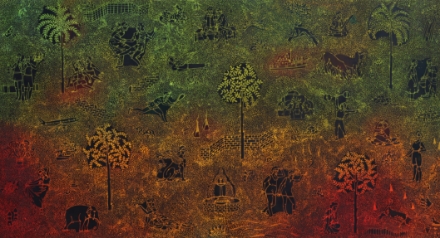
Born in 1988, is a contemporary artist whose practice is characterized by a distinctive romantic eclecticism, weaving a postmodern visual tapestry that reflects contemporary life through layered historical references. He earned a Bachelor of Visual Arts (BVA) in Painting in 2011 and a Master of Visual Arts (MVA) in Painting in 2013, both from M.S. University, Baroda. His work draws on diverse artistic traditions, particularly Persian miniature painting, while incorporating elements inspired by Indian craft practices such as Kantha and Gond visual languages. Viramgami’s compositions are complex and often large-scale, juxtaposing imagery from different historical periods to create anachronistic narratives that blur temporal boundaries. His surreal, camouflaged environments frequently feature architectural forms resembling origami-like structures, providing a dynamic stage to explore the interplay of history, memory, and identity. His works investigate the ways shifting sociopolitical forces influence human relationships and lived realities, presenting time as a fragmented continuum in which subjugation and liberation coexist. He has exhibited extensively in India and internationally, with notable exhibitions including “Paradise Regained” at Palette Art Gallery, New Delhi (2024); multiple editions of the India Art Fair in collaboration with Latitude 28; Art Dubai (2025); Art SG, Singapore (2023); and Delhi Contemporary Art Week at Bikaner House, New Delhi. He has also participated in prestigious platforms such as the Kochi-Muziris Biennale (2018–19), and exhibited at CIMA Art Gallery, Kolkata; Jehangir Art Gallery, Mumbai; Gallery Espace, New Delhi; and the Prince of Wales Museum, Mumbai. Viramgami’s achievements include the Elizabeth Greenshields Foundation Award (2017), the Sanskriti Kala Puraskar National Award (2017), and the Jeram Patel Award (2011). His works continue to engage with historical layering, cultural memory, and the nuanced dynamics of contemporary life.